ActionTypes® is an approach that comes from high-level sports coaching.
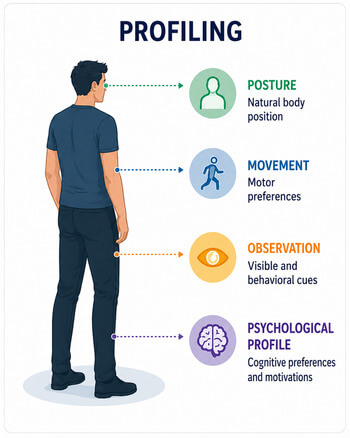
It connects posture, motor preferences, and psychological functioning to reveal certain aspects of a coachee’s functioning that are not addressed by more traditional cognitive approaches.
This page shows how this approach can help you:
- Identify a person’s Deep Motivational Drivers;
- Understand how they influence their MBTI® profile;
- Identify and validate their MBTI® type while reducing the difficulties linked to bias and limited self-awareness.
ActionTypes®: The Link Between Body and Brain
ActionTypes® is a model that was discovered and refined over 25 years of using the MBTI® in coaching and in the preparation of high-level athletes. It was developed by Bertrand Théraulaz and Ralph Hippolyte, two experienced professional coaches.
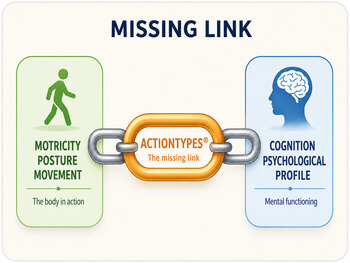
This approach establishes objective correlations between the body and the brain. It shows how our posture and natural motor preferences reflect our Jungian cognitive preferences.
The originality and richness of the ActionTypes® model come from the links it highlights between:
- The body, through a person’s motor preferences and preferred muscle chains;
- The brain, through Jung’s cognitive preferences, which were later popularized by the MBTI®.
In practical terms, Ralph Hippolyte and Bertrand Théraulaz showed that our posture and the way we move are connected to our MBTI® profile. What the MBTI® often reveals in this context, ActionTypes® makes observable through the body. This discovery changes the way we understand and support each person, both in coaching and in sports preparation.
Beyond its use in sports coaching, ActionTypes® is a valuable tool that we use in our MBTI training to help people better understand themselves and validate their profile more reliably, with fewer biases.
ActionTypes® Profiling: A Reliable Tool for Identifying Motor and Cognitive Preferences
The links between posture, movement, and MBTI® profile have made it possible to build a sophisticated and well-tested ActionTypes® profiling protocol.
Compared with MBTI®, CCTI®, or JTI® questionnaires followed by type validation, its main value lies in one specific point: it greatly reduces biases related to self-image, stereotypes, and social desirability.
For this reason, it is one of the most reliable tools we know for helping someone identify their true MBTI® profile. Natural movement can sometimes reveal what questioning alone does not bring out.
This profiling process also has another benefit: it supports the MBTI® type discovery interview when a person:
- Does not yet know themselves very well;
- Is going through a transition period;
- Finds it difficult to answer their trainer’s clarification questions.
In real coaching situations, this is often where the ActionTypes® approach brings the most value, especially when someone is experiencing confusion around their identity.
Deep Motivational Drivers: Beyond MBTI® Preferences
Deep Motivational Drivers were identified by Ralph Hippolyte and Bertrand Théraulaz as part of this approach.
They are different in nature from MBTI preferences: Sensing (S), Intuition (N), Thinking (T), and Feeling (F).
These preferences are the ways our brain naturally connects to information and processes it. We use them unconsciously, more easily and more often, because they are more “economical” for the brain and feel like the natural way to function.
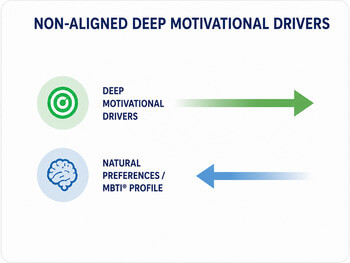
Deep Motivational Drivers, as the name suggests, are more connected to an unconscious attraction to a certain way of doing things.
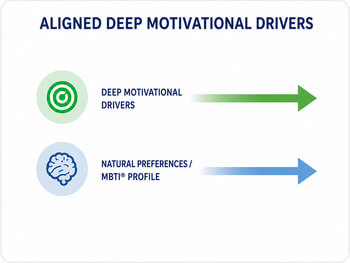
For some people, Deep Motivational Drivers and preferences are aligned. For others, they differ.
Deep Motivational Drivers Influence the Expression of the MBTI® Type
The influence of Deep Motivational Drivers on the expression of the MBTI® profile and on behaviour can be considerable.
What the ActionTypes® model often reveals in this context is that two people with the same MBTI® profile can function very differently.
Let’s take an example we experienced with four colleagues, all identified as INFP.
Each of them recognized themselves in this profile, while also feeling very different from the other three. In fact, they found it hard to accept that they shared the same type.
Exploring their Deep Motivational Drivers confirmed this gap. Their drivers were different from one person to another, which created distinct ways of functioning, even though their preferences were similar.
When Deep Motivational Drivers Are Aligned with MBTI® Preferences
When a person’s Deep Motivational Drivers are consistent with their MBTI® preferences, their behaviours often appear more strongly. The drivers and preferences then reinforce each other.
Here is a concrete example.
Jacques is a financial director in a service company. His MBTI® profile is ISTP. He is oriented toward concrete action, with a desire for tangible, visible results that appear quickly. He analyzes operational problems very fast.
He can easily feel uncomfortable when a colleague becomes emotional. His communication can be very direct, with a tendency toward sarcasm. He also likes having the last word, and he is quite comfortable in that kind of exchange.
When his Deep Motivational Drivers were explored through the ActionTypes® approach, it became clear that they reinforced his analytical side, his potential for sarcasm, his competitive way of engaging in discussions, and his need to have the last word.
In this case, the consistency between his MBTI® preferences and his Deep Motivational Drivers makes certain behaviours more pronounced. It also makes the work on softening his communication and developing empathy more demanding.
When Deep Motivational Drivers Contradict Preferences: Flexibility and Profile Confusion
When a person’s drivers are the opposite of their MBTI® preferences, they may develop greater flexibility in adapting to different situations. However, they often have more difficulty identifying their true MBTI® profile. This situation can be delicate, but it also opens up very concrete paths for development.
Here is a concrete example.
Didier has a lot of difficulty determining whether his preference is Thinking (T) or Feeling (F), and this bothers him. His natural ways of functioning sometimes look like those of an INTP and sometimes like those of an ENFJ.
ActionTypes® profiling shows Deep Motivational Drivers that are opposite to his preferences.
His communication corresponds to a Thinking profile, because his MBTI® preference is indeed INTP. However, he regularly adopts behaviours that may bring an ENFJ to mind because of his Deep Motivational Drivers.
This understanding reassured Didier about a way of functioning that had previously seemed hard to explain. It was connected to a tension between deep relational needs and natural preferences that are more oriented toward logic.
This more precise reading of a coachee’s profile makes it possible to offer coaching that is better adjusted to the person and more useful over time.
ActionTypes®: A Reliable Tool for Identifying the MBTI® Profile Without Bias
When ActionTypes® is used as part of an MBTI® type validation interview, the observed correlation between ActionTypes® testing results and the MBTI® profiles validated by participants is often high.
This reliability is explained in part by the observation of movement, which is not filtered in the same way by mental and cultural biases.
ActionTypes® can therefore be especially useful for supporting people who have difficulty identifying their profile.
In real-life use, this profiling helps to:
- Bypass the effects of stereotypes and social desirability;
- Compensate for certain limits in self-understanding;
- Clarify uncertainties when Deep Motivational Drivers and preferences differ.
ActionTypes® profiling is a valuable tool for clarifying a person’s deeper personality identity and creating a more stable basis for development work.
ActionTypes®: The Missing Link Between Movement and Cognition
The originality and richness of the ActionTypes® model lie in the way it brings together two worlds that are too rarely connected:
- The body, through the motor preferences identified by Raymond Sohier and the muscle chains described by Godelieve Denys-Struyf;
- The mind, through Jung’s psychological preferences, popularized by the MBTI®, as well as Deep Motivational Drivers, a contribution from Bertrand
Théraulaz and Ralph Hippolyte that significantly enriches our understanding of human functioning.
The entire ActionTypes® program is based on the causal links and correlations observed between psychological preferences and bodily preferences.
These links have been better understood and made more objective through Lowen’s work on bioenergetics, Pribram’s work on the cerebral cortex, and Katherine Benziger’s work on cerebral lateralization. Through more than 25 years of work with high-level athletes and professional coaches, Bertrand Théraulaz and Ralph Hippolyte turned these discoveries into a practical and verifiable approach, useful in adaptive coaching as well as in the development of individual performance.
The ActionTypes® approach shows that every person has natural strengths that deserve to be recognized and used.
The deeper work begins there: identifying what functions spontaneously, then building on it instead of forcing a way of functioning that does not hold up over time.
In practice, this reading changes the way we approach coaching, sports, and team communication. It gives us a simple reference point to test: observe what creates ease, precision, and energy, rather than what requires constant effort.
Once personality types are clarified through body-based testing, they become concrete supports for performance, not fixed categories.
From Profiling to Action: How ActionTypes® Optimizes Coaching
In real coaching situations, the dynamic changes when the coach adapts their approach based on ActionTypes® results.
Each type responds to a distinct style of questioning, different motivational levers, and specific learning contexts.
Adaptive coaching is based precisely on this prior identification, in order to shorten development paths and make them more relevant.
A coach who knows your motor and cognitive preferences, your Deep Motivational Drivers, and your personality type can calibrate each session more accurately.
The deeper work begins there: adjusting the pace, the structure, and the nature of the exercises according to what truly supports your learning. This applies just as much to stress management as it does to a career transition or leadership development.